

Reference isn’t copying. It’s training your eye.
Most artists don’t use reference to “find something to copy.”
We use it to see better.
To understand why a dragon reads at a distance.
Why a peony holds its shape in a sleeve.
Why do some compositions feel calm, and others feel like they’re moving?
Reference is where you borrow structure, not identity.
And that’s why we love books as reference: they slow you down. They get you off the endless scroll. They give you complete pages, full compositions, and details you can actually study.
Here are a few practical ways tattoo artists use reference books in the studio — and a few simple exercises you can try today.
Download the 3-page Studio Guide (PDF)

1) Study the “big shapes” first (composition > details)
A common mistake: jumping straight into details.
Instead, start from far away.
Ask:
- What’s the silhouette?
- Where’s the weight?
- What’s the direction of flow?
-
How does the composition “sit” on an imagined back, sleeve, or panel?
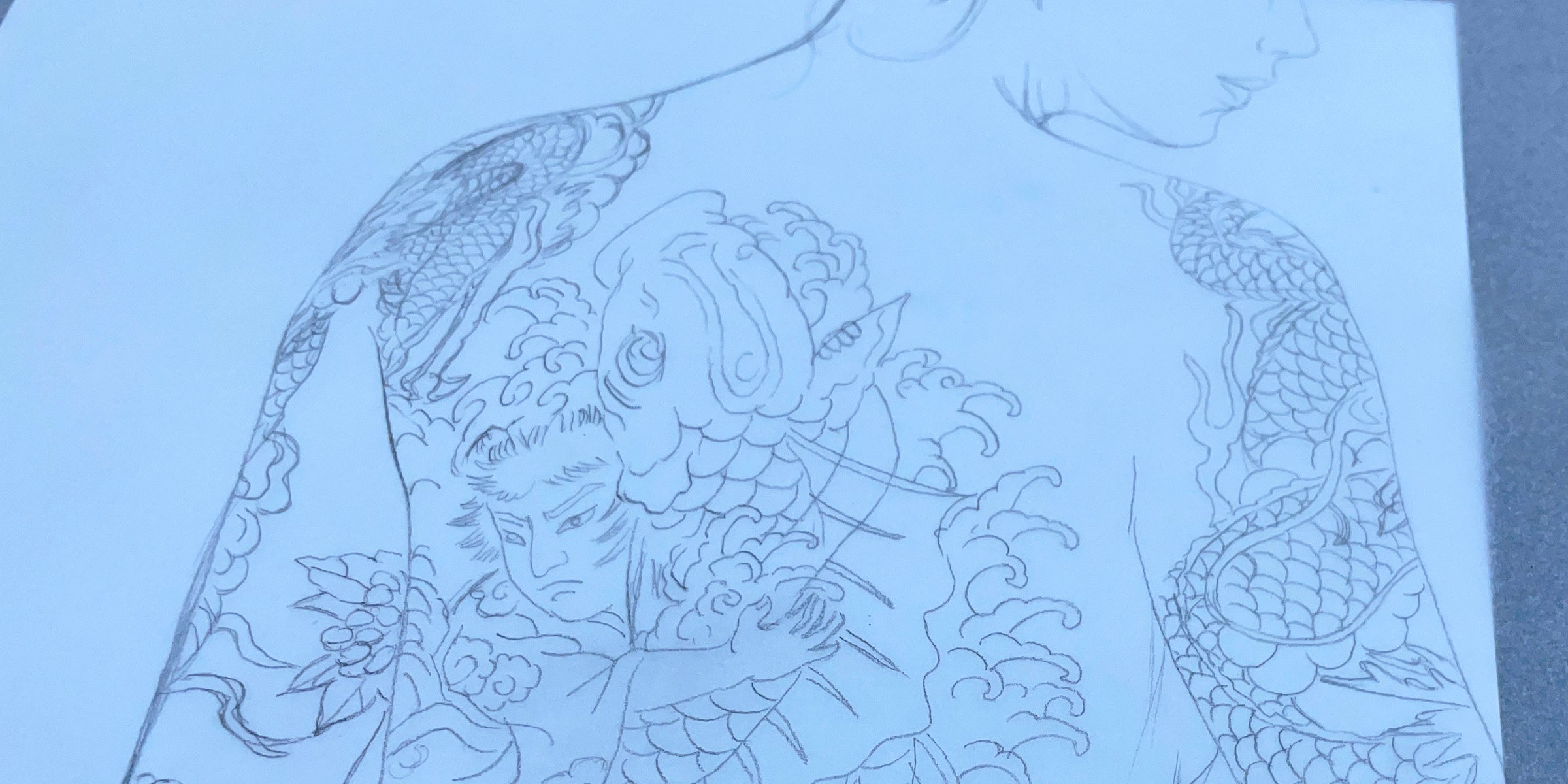
Books like Scrolls II are perfect for this kind of study because you can read a full composition in one view and then zoom into the details after. The long vertical gatefold format makes it easy to follow the movement through the entire piece.
Quick studio drill (5 minutes):
Pick one image. With a marker or brush pen, do a tiny thumbnail (like 5–7 cm). No details. Only the big shapes and the main flow.
2) Build a motif library (variation is the secret)
Tattooing is full of shared symbols — but what separates strong work from generic work is variation.
Reference books help you collect variations of the same motif:
- multiple peony structures (open vs tight)
- different leaf rhythms
- different dragon heads, horns, whiskers
-
different ways to solve the same problem
Japanese Flora Vol. 2 is a great example of reference that supports this kind of study: it’s built around floral motifs and includes guidance on when/how to use them, plus traditional design elements like kamon (family crests) that give you more vocabulary to pull from.
Quick studio drill (10 minutes):
Choose one flower and draw six variations:
- 2 versions simplified for readability
- 2 versions more detailed (for larger placements)
- 2 versions with a different rhythm (more round / more sharp)

3) Use reference for repetition (discipline creates style)
Style doesn’t come from a single drawing. It comes from repetition.
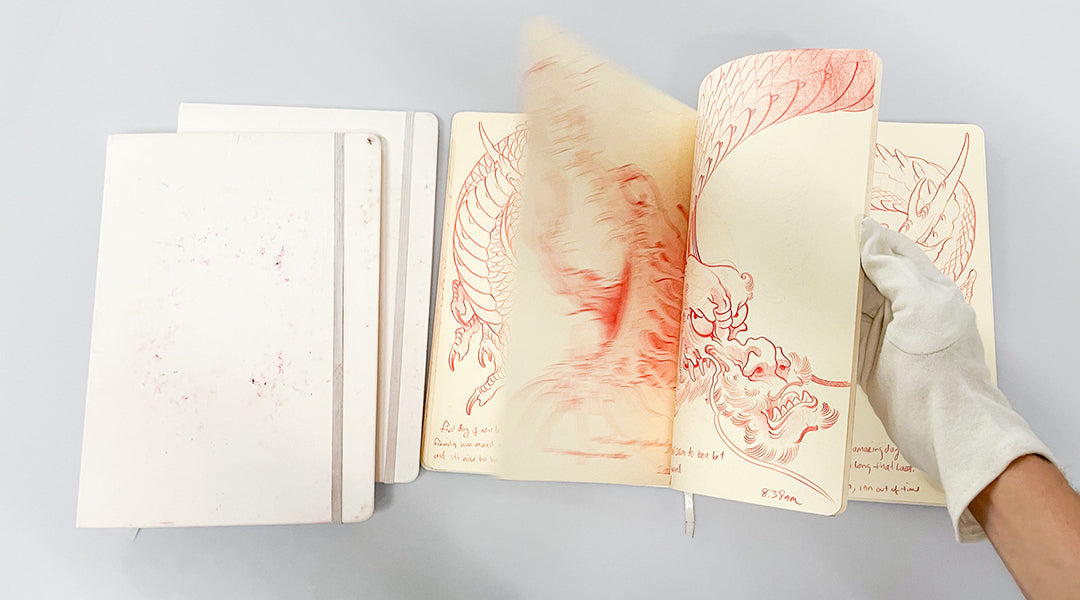
That’s why daily practice formats are so useful: they show you how an artist solves the same motif hundreds of times, with small shifts each day.
Daily Dragon Sketches – Spring comes from a year-long practice of drawing dragons daily, and that kind of repetition is one of the fastest ways to develop your own decisions about flow, anatomy, and shape language.
Quick studio drill (15 minutes):
Pick one dragon head you like. Draw it 5 times:
- 1: copy the structure (not the line)
- 2: change the jaw shape
- 3: change the eye + brow expression
- 4: change the horn/whisker rhythm
- 5: redraw it from memory
You’ll feel your own version appear by #3.

Download the 3-page Studio Guide (PDF)
4) Translate reference into tattoo decisions
A reference image becomes a tattoo only after translation:
- What gets simplified?
- What gets thickened?
- What gets removed for clarity?
-
Where do you leave breathing room?
This is where books beat random online images: you’re seeing work presented intentionally, at high quality, so you can make better translation choices.
Rule we like in the studio:
If it doesn’t read from 2 meters away, it probably won’t age well.
So when you use reference, don’t ask “Can I draw this?”
Ask “Can I tattoo this so it lasts?”
5) Turn reference into your flash
The goal isn’t to recreate a page.
The goal is to create a new page that couldn’t exist without your taste:
- your line decisions
- your spacing
- your simplifications
-
your composition instincts
Simple workflow:
- collect 3 references (composition / motif / texture)
- do one thumbnail that combines the ideas
- redraw it clean as flash
-
tattoo it (or paint it) and revise
That’s how reference becomes authorship.
If you want to go deeper
If you’re building a studio reference shelf right now, here are three strong “use it immediately” directions: Composition + flow: Scrolls II
Floral vocabulary + structure: Japanese Flora Vol. 2
Daily practice + dragons: Daily Dragon Sketches – Spring

Leave a comment
This site is protected by hCaptcha and the hCaptcha Privacy Policy and Terms of Service apply.