

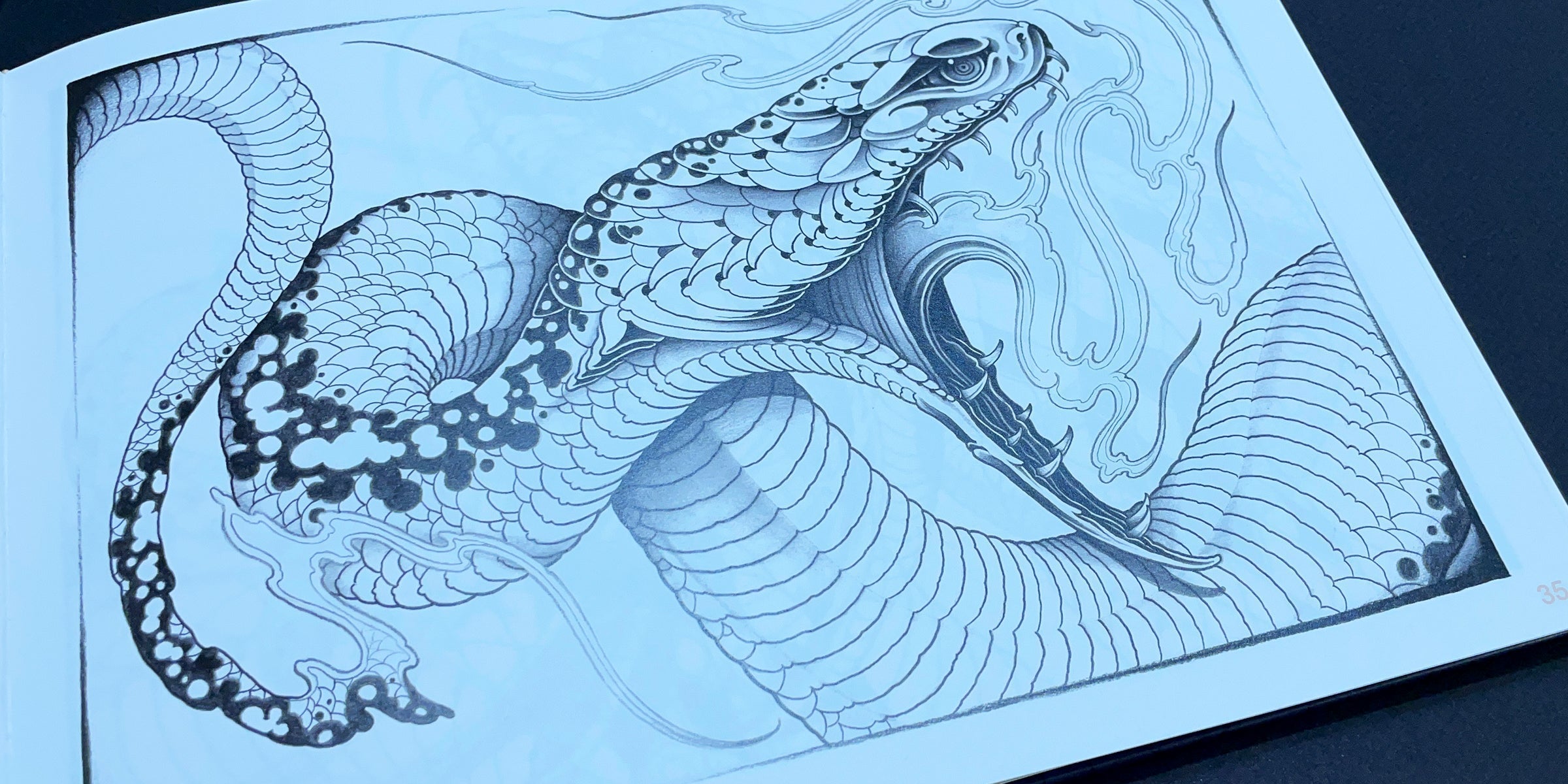
Spread from Daily Dragon Sketches – Summer by Bill Canales.
If your drawing feels “off,” it’s rarely because you didn’t add enough detail.
It’s usually because the layout isn’t working.
- the flow doesn’t carry
- the focal point is unclear
- the shapes don’t read from a distance
- the design fights the body instead of fitting it
Flow comes first. Detail comes last.
We don’t sell motivation. We build studio discipline.
Why “flow” matters (especially in tattooing)
A tattoo isn’t viewed like a photo. It’s seen:
- in motion
- from an angle
- from across the room
- on a body that bends
That means you’re not designing for “zoomed in.”
You’re designing for readability.
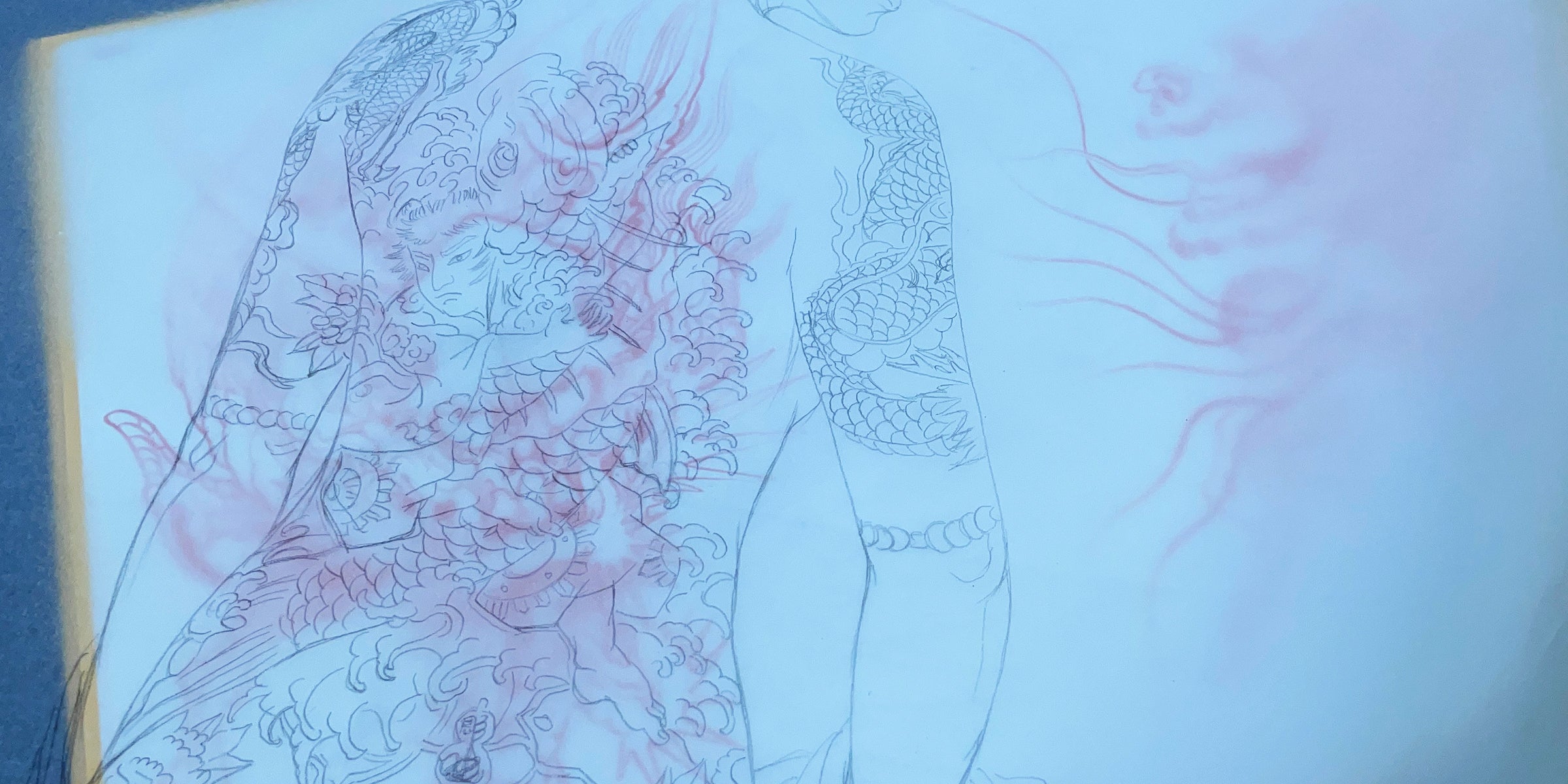
In irezumi-inspired work, flow is the language.
If the flow is strong, the piece holds together—even with minimal detail.
The mistake: detailing too early
Detail is seductive because it feels productive.
But detail is often just a way to avoid making hard decisions.
If the big shapes don’t work, detail becomes decoration.
So here’s the discipline:
Don’t earn detail until the layout reads.
The 10-minute flow drill (do this daily)
Pick one reference page. Set a timer.
1) Find the spine (2 minutes)
Draw one line that represents the main movement.
This is the path the eye travels.
Quick check: blur your eyes—do you still feel the direction?
2) Place one focal point (2 minutes)
Choose one area to carry the most weight (contrast/detail).
Everything else supports it.
Rule: one hero, not three.
3) Block big shapes only (4 minutes)
Add 3–5 big shapes that support the spine and point back to the focal point.
No texture. No pattern. No small stuff.
4) Add breathing room (2 minutes)
Remove, open, simplify.
Create space for the eye to rest.
Tattoo-distance check: step back. Does it still read?
That’s the rep.
Repeat tomorrow with a new page.
Scroll-style thinking (a simple model)
Even if your final tattoo won’t be vertical, scroll composition teaches structure.
Try this:
- Top = entry (where the eye begins)
- Middle = story (interaction + rhythm)
- Bottom = exit (where the movement resolves)
You’re training how a scene holds together—before you decorate it.
A reference we study for flow
If you want to study composition at a very high level, pair this practice with:
Scrolls II — Horiyoshi III
Study it for:
- movement through the whole piece
- focal hierarchy
- spacing and breath
- how “big shapes” carry the story
Free download (print this workflow)
Want the drill as a printable framework?
→ Download the Free Irezumi Flow & Layout Guide (PDF)
Next in the series
Next: Study Without Copying — keep the lesson, change the result.

Leave a comment
This site is protected by hCaptcha and the hCaptcha Privacy Policy and Terms of Service apply.