

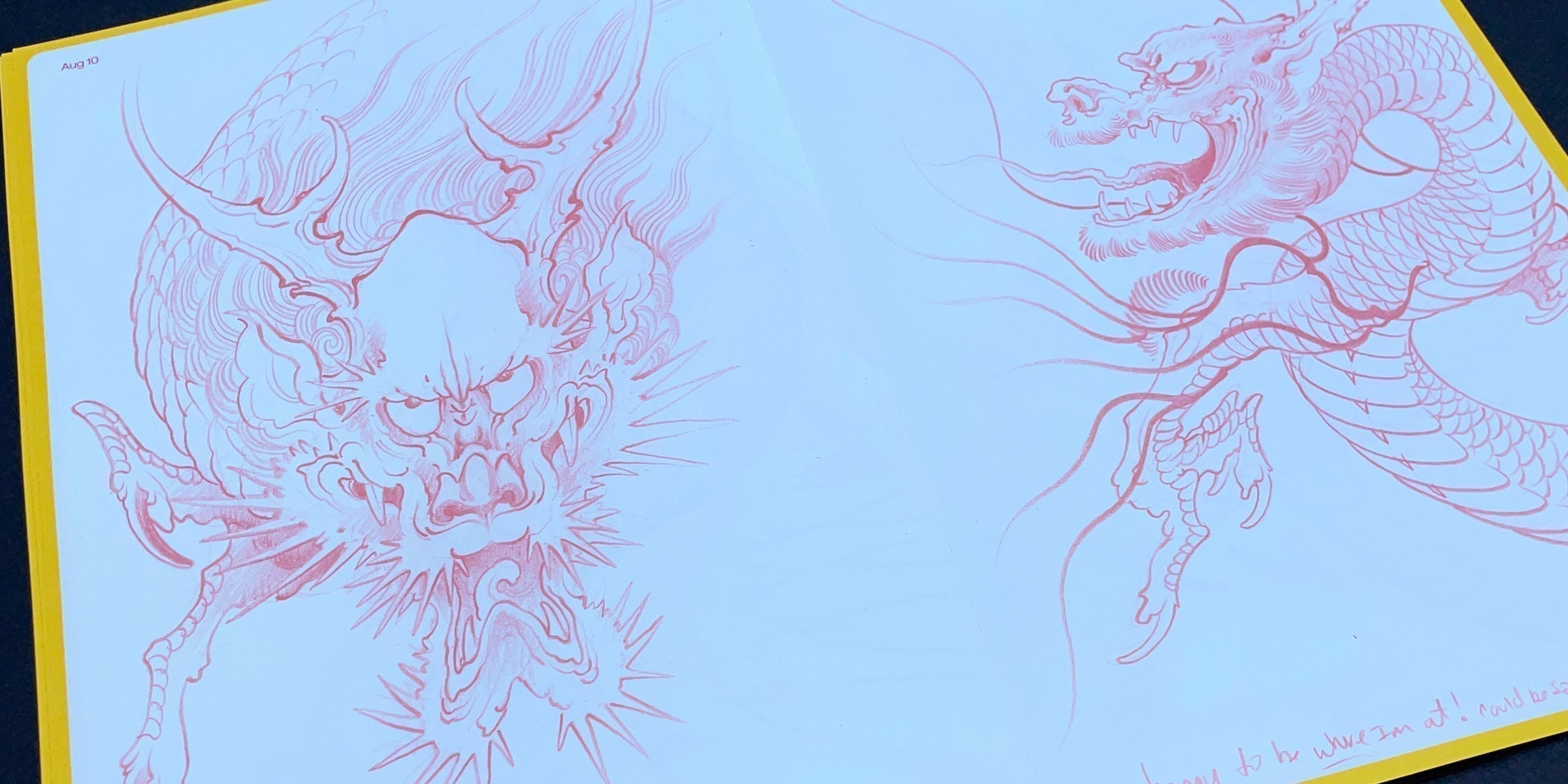
Drawing excerpt from The Geometry Behind Snakes and Dragons by Sören Sangkuhl.
Most artists don’t want to copy.
But we also don’t want to stare at a blank page.
Reference is the bridge.
The problem is how you use it.
Copying is output. Studying is decision-making.
We don’t sell motivation. We build studio discipline.
The simplest definition
Copying is:
Trying to recreate the same image.
Studying is:
Extracting principles you can use again.
One makes a replica.
The other makes you better.
The “principles, not pixels” rule
When you open a reference book, don’t ask:
“How do I draw this exact thing?”
Ask:
“What decisions make this work?”
Here are the decisions that matter most:
- flow (where the eye travels)
- hierarchy (what gets the most weight)
- big shapes (what holds the design together)
- spacing (where the work breathes)
- rhythm (repetition and variation)
If you learn those, you can build your own work from scratch.
The 10-minute study method
Pick one reference page. Set a timer.
1) Extract 3 principles (3 minutes)
Write three quick notes. Example:
- “Strong S-curve spine”
- “One heavy focal point, everything else lighter”
- “Big dark shape balanced by open space”
2) Cover the page + rebuild structure (4 minutes)
Redraw only:
- the spine
- 3–5 big shapes
- the negative space
No details.
3) Change the result (3 minutes)
Make it yours by changing at least two of these:
- subject (dragon → koi, flower → mask, etc.)
- angle (front view → 3/4)
- placement (vertical → diagonal / wrap)
- proportions (longer, tighter, wider)
- rhythm (dense vs open)
- style choices (line weight, black distribution)
Keep the lesson. Change the result.
What “ethical study” looks like
A good test:
If someone placed your drawing next to the reference, would it read as:
- a new design built from the same principles, or
- the same design with small changes?
Aim for the first.
Your goal is to build your visual library and your taste—without borrowing someone else’s
finished solution.
The discipline that makes this work
Write what you learned.
Every session, one sentence.
Because the sentence is proof you studied decisions, not pixels.
“Today I learned how the focal point is supported by open space.”
That’s the rep you can repeat tomorrow.
Free printable (use this in the studio)
If you want this workflow as a one-page desk guide:
→ Download: Study Without Copying (Free PDF)
Next in the series
Next: One Motif, 20 Variations — how style is built.

Leave a comment
This site is protected by hCaptcha and the hCaptcha Privacy Policy and Terms of Service apply.