

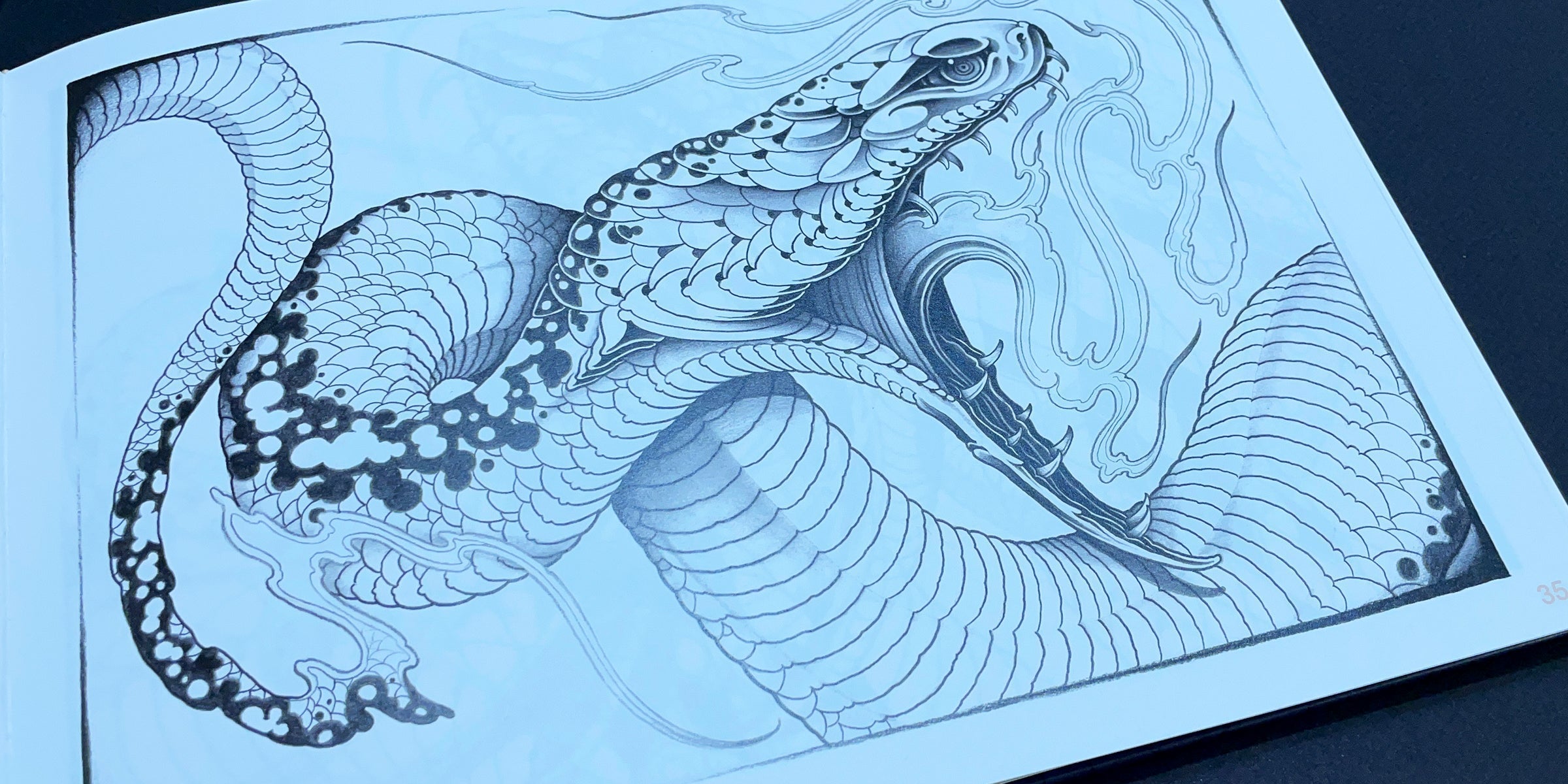
Excerpt from Clean Solid Tattoo Designs Vol. 1 by Robert Aalbers.
Most artists want “more ideas.”
But ideas don’t appear out of nowhere.
They come from reps.
Style is repetition with intention.
We don’t sell motivation. We build studio discipline.
The trap: waiting for the perfect idea
If you only draw when you have a “great concept,” you’ll produce less—and learn slower.
A better approach is to take one simple motif and explore it until you understand it.
That’s how your eye improves.
That’s how your hand improves.
That’s how your taste becomes yours.
The rule
Pick one motif.
Repeat it 20 times.
Change one decision each time.
Not randomly—intentionally.
You’re training:
- structure
- rhythm
- proportions
- readability
- choices you can repeat later
Motifs that work well
Choose something simple enough to repeat quickly:
- flower / leaf / peony
- wave / cloud / wind bar
- snake head / dragon claw
- dagger / heart / star
- mask / skull
- knot / rope / chain
The simpler the start, the stronger the reps.
The 20-variation drill (30–45 minutes)
Step 1: Make a base version (5 min)
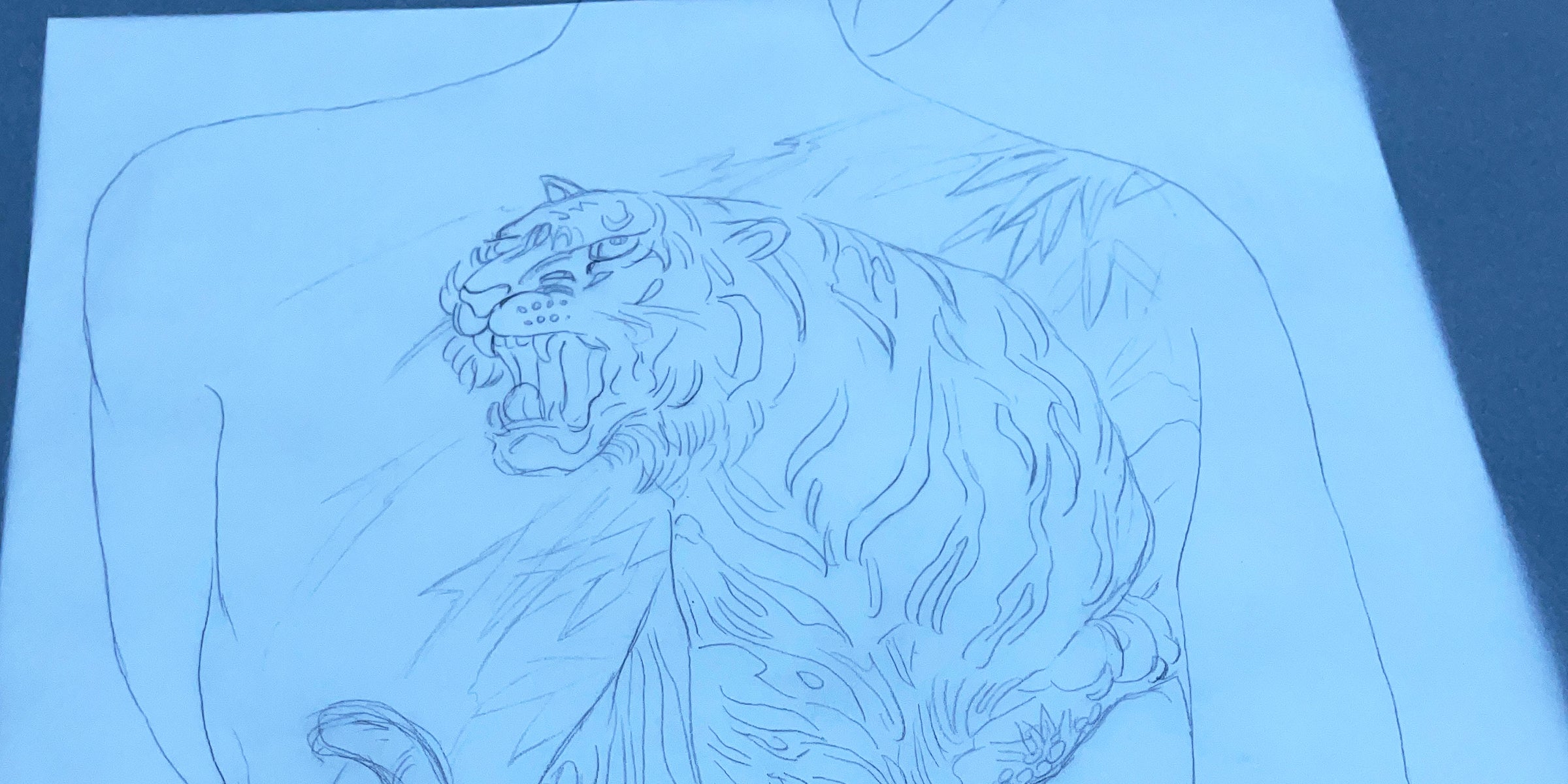
Draw the motif once with clean, simple structure.
This is version #1.
Step 2: Push variations in “sets”
Do 5 variations per set. Don’t overthink—keep moving.
Set A — Proportions (5 variations)
Change:
- taller vs wider
- longer vs tighter
- heavier top vs heavier bottom
- compressed vs stretched
- thick vs thin silhouette
Set B — Rhythm (5 variations)
Change:
- calm vs aggressive movement
- smooth vs jagged transitions
- dense vs open spacing
- repetition frequency
- symmetry vs asymmetry
Set C — Shape language (5 variations)
Change:
- round vs sharp
- soft vs angular corners
- big curves vs straight segments
- simple shapes vs complex shapes
- chunky vs elegant
Set D — Black & negative space (5 variations)
Change:
- where the weight sits
- how much black you use
- how you reserve highlights
- how you separate layers
- how the motif “breathes”
Now you have 20 solutions from one seed.
That’s a library.
The part most people skip (and why it matters)
After the 20, circle your best 3.
Write one sentence:
What do these three have in common?
That sentence is your style forming.
Quick studio version (10 minutes)
No time? Do a mini version:
- 1 base motif
- 4 fast variations
- pick the best one and redraw it cleaner
Ten minutes counts.
Free printable (make this easy)
Want a printable grid + prompts so you can run this drill fast?
→ Download: One Motif, 20 Variations (Free PDF)
Next in the series
Next: From Study to Finished Work — a simple weekly output system.

Leave a comment
This site is protected by hCaptcha and the hCaptcha Privacy Policy and Terms of Service apply.