
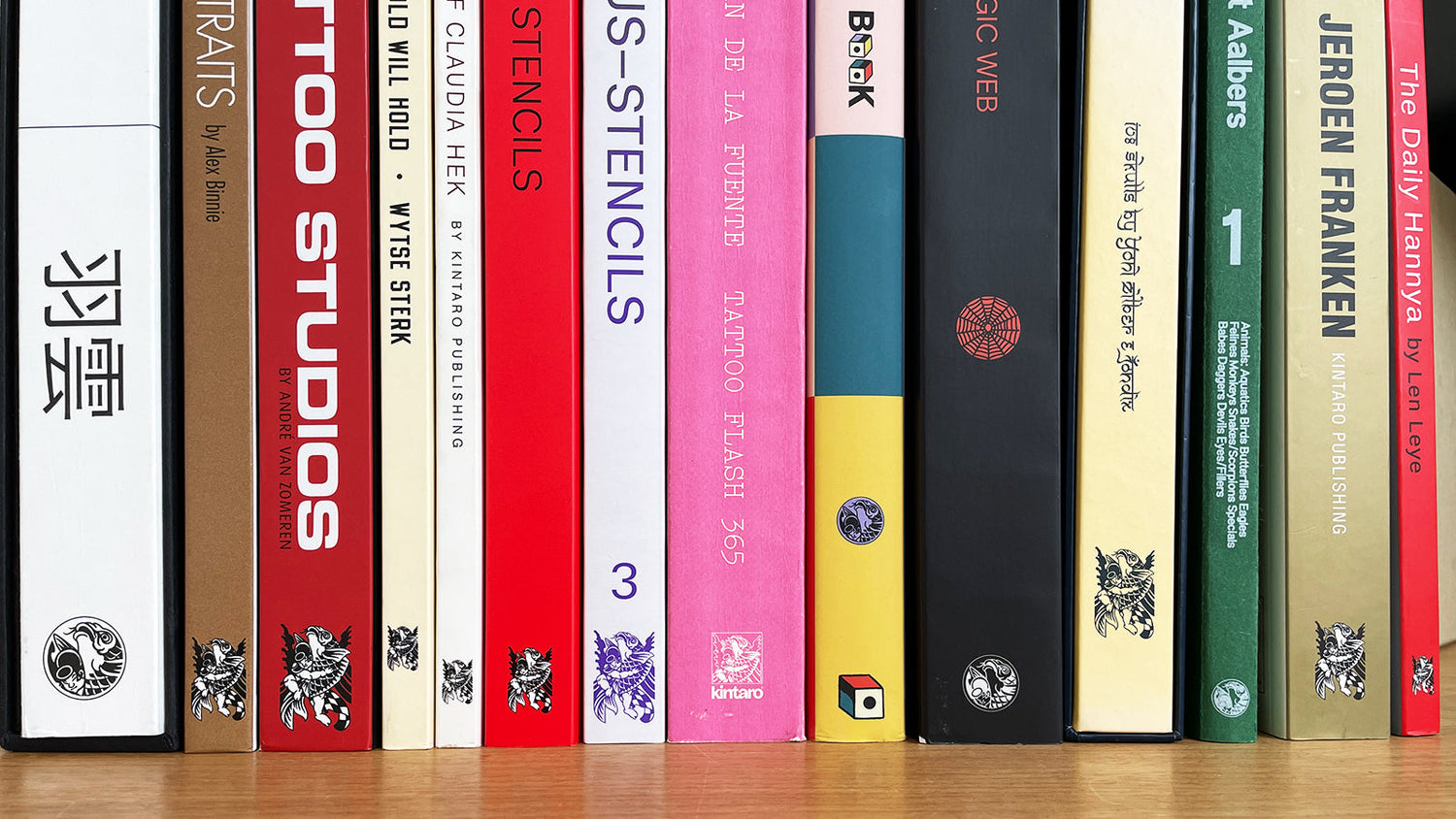
There has never been easier access to images.
A few taps, a few searches, a few saved folders, and the world is full of reference again. More dragons. More flash. More paintings. More sleeves. More history. More inspiration than anyone could ever fully absorb.
That sounds like abundance.
But access is not the same as attention.
And attention is not the same as study.
That difference matters more than ever — especially in tattooing, where so much depends on memory, judgment, repetition, taste, and the slow shaping of the eye.
Because the question is no longer whether images are available.
The question is what actually stays with you.

What a real reference shelf gives you
- slower attention
- stronger memory
- sequence and context
- something to return to
- a clearer sense of taste
- a relationship, not just access
Access is instant. Relationship takes time.
A stream of images can give you options.
A book can give you relationship.
That may sound romantic, but it is also practical.
When you live with a book, you do not only see what is inside it once. You return to it. You notice different things. A spread that meant one thing a year ago can mean something else now. A detail you ignored becomes useful later. A sequence of images starts to make more sense because you have changed, not because the book has.
That kind of relationship is difficult to build through endless scrolling.
Scrolling is fast. It is efficient. It can be useful. But it is also designed to keep one image from settling before the next one arrives. It encourages reaction more than return. It gives you constant novelty, but not always depth.
A serious reference shelf works differently.
It asks for more from you. But it also gives more back.
Books and records have more in common than people admit

There is a reason collectors still care about records, even when almost any song can be streamed instantly.
It is not only about nostalgia. It is about the experience of choosing.
A record asks for attention. You pick it deliberately. You hold it. You look at the cover art. You listen in sequence. You stay with it a little longer. The object becomes part of the ritual, not just the content.
Books work in much the same way.
A tattoo book is not only a storage device for images. It is a way of organizing attention. The cover matters. The pacing matters. The order matters. The way images sit next to each other matters. The object slows you down enough for the work to start opening up.
That is part of why collecting books still matters.
Not because access is scarce.
But because attention is.

Fast inspiration and lasting reference are not the same thing
Fast inspiration has its place.
Sometimes one image is enough to unlock an idea, solve a compositional problem, or send your mind in a better direction. There is nothing wrong with that. The problem begins when all reference starts to become disposable.
When that happens, images stop shaping taste and start behaving like passing prompts.
A good tattoo book does something else.
It gives form to a body of work. It lets you compare. It lets you revisit. It gives you context. It helps you understand not only what an image looks like, but how an artist thinks, repeats, varies, edits, and resolves things over time.
That is where deeper reference begins.
Not in having more images.
In staying with better ones for longer.
If you want a more practical look at how artists actually work with books in the studio, read our guide on How artists use reference books.
A strong shelf is not built to impress

This is where collecting can be misunderstood.
A strong shelf is not built to impress other people.
It is not a flex. It is not just décor. It is not there to signal taste without actually shaping it.
A strong shelf is a tool.
It tells you what you are returning to. It reflects what you value enough to keep close. It helps you build an environment around your practice, your curiosity, and your standards.
That matters whether you are a working tattooer, an apprentice, or a collector who cares deeply about the culture.
Because what you keep near you begins to influence how you see.
And over time, how you see influences what you make, what you choose, and what you are able to recognize as strong.
That is the real point of collecting.
Not ownership for its own sake.
A slower, more deliberate relationship to the things that shape your eye.
What makes a tattoo book worth keeping
Not every tattoo book deserves the same place on the shelf.
Some are exciting once and then flatten out. Some are beautifully produced, but do not give much back after the first pass. Some offer plenty of images, but not much staying power.
The books worth keeping tend to do something more.
They have a point of view.
They reward slow study.
They teach something beyond the obvious subject matter.
They help you notice structure, rhythm, variation, editing, confidence, visual language, cultural depth, or discipline.
They hold up over time.
That last part is important.
A book worth keeping is rarely exhausted quickly. It changes as your own eye changes. You do not outgrow it in a month. You grow into it differently over years.
That is one of the clearest signs that a book belongs on a serious shelf.
It keeps giving.
Why this still matters in tattooing

Tattooing has always depended on repetition, memory, variation, and the passing on of visual knowledge.
That knowledge does not only travel through direct apprenticeship or conversation. It also travels through what artists keep around them: flash sheets, paintings, sketches, photos, books, and collections that become part of the studio environment.
Books matter inside that ecosystem because they make a body of work portable, durable, and returnable.
They let artists live with images in a way that is different from simply consuming them. They make certain forms, ideas, and ways of seeing available for repeated contact.
And repeated contact matters.
Because good judgment is not built in one sitting. It is built through return.
That is true whether you are studying Japanese reference, old flash, dragons, blackwork, paintings, line drawings, or the visual habits of a single artist.
The right book becomes part of that process.
We explored one example of this more directly in How tattoo artists use Japanese reference without copying.
Where Kintaro enters
This is also what Kintaro should be trying to publish.
Not more noise.
Not more images for the sake of volume.
Books worth returning to.
Books that reward slow attention. Books that help artists and collectors sharpen the eye, build taste, and deepen their relationship to the craft. Books that do more than fill a shelf.
A serious tattoo book should not only look good once.
It should stay useful.
It should stay alive.
It should feel like something you can return to on a quiet Sunday, pull from the shelf deliberately, spend time with properly, and leave changed by — even if only slightly.
That is very different from simply having access.
And that difference is why books still matter.
Final thought

The point is not to collect more.
It is to return more carefully.
In an age of endless images, that may be the real value of a physical reference shelf. Not scarcity. Not nostalgia. Not performance.
Deliberate attention.
The right book slows you down just enough to see more. It helps you build memory instead of reaction. Judgment instead of accumulation. Taste instead of noise.
And over time, that becomes part of the work.
Not because the shelf looks impressive.
Because it quietly changes the way you see.
Build a stronger reference shelf
If you care about books worth returning to — not just collecting for the sake of it — start with a few titles chosen for slow study, visual depth, and lasting value.


Leave a comment
This site is protected by hCaptcha and the hCaptcha Privacy Policy and Terms of Service apply.